
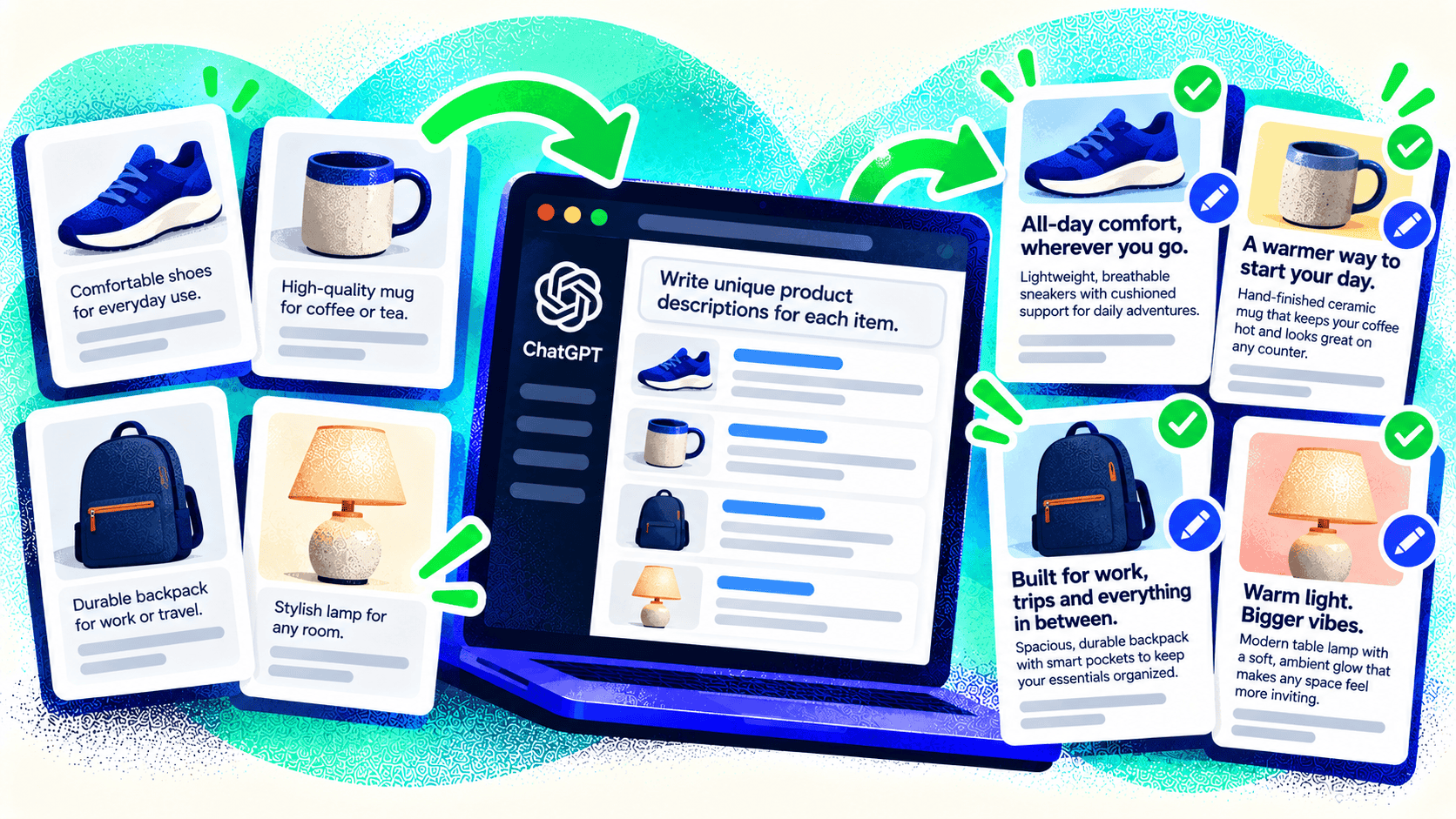
AI can draft a product description in seconds. It can also turn a distinctive catalog into pages full of “premium quality,” “perfect for any occasion,” and claims no one checked. A better approach is to give the tool verified product facts, a clear audience, and an editing process. Let it reduce repetitive writing time while your team keeps responsibility for accuracy and voice.
Shopify’s product description guidance makes this point directly: merchants are responsible for the accuracy of generated content, and AI may add benefits or facts that were not provided.
Build a reliable product brief first
For each product, collect the information a buyer needs: materials, dimensions, fit, compatibility, care, what is included, and limits or exclusions. Add the intended customer and the decision the description should help them make. If facts are missing from the catalog, find them before asking AI to fill the gap.
For a large catalog, make a brief template by category. A furniture description may need dimensions and assembly details; a replacement component needs compatibility and installation information. A shared template gives writers and AI tools better inputs without making every finished page sound identical.
Ask for useful copy, then verify every claim
Prompt the tool to explain the product in plain language using only the supplied facts. Ask it to lead with the most important buyer benefit and follow with concrete details. Avoid instructions to make every item “luxury,” “game changing,” or “best in class.” Those phrases are easy to generate and hard to prove.
Have a person check specifications, claims, links, variant differences, and tone. Remove invented performance statements and vague adjectives. If two products have different uses, the descriptions should make that difference clear enough for someone to choose.
Write for a real comparison
A strong description helps a shopper answer: Is this for me? Which option should I choose? Will it work with what I own? What happens if it doesn’t? Use clear headings or short sections for specifications when the product is complex. Add original photography, guides, and FAQs where copy alone can’t explain the decision.
Search visibility follows usefulness. A page that repeats the same keyword but omits size, material, or compatibility gives both customers and search systems less to work with.
Improve the process, not just the prose
If the same factual errors appear repeatedly, the issue may be the product data source. Decide where specifications are maintained and how they reach the store. AI writing will not compensate for an out-of-date catalog or inconsistent variant records.
Through AI Ecommerce, Kelp works on custom ecommerce catalogs and storefronts. If product copy is difficult because the underlying data is scattered, talk with us about the catalog workflow as well as the page content.


Leave a Comment